Connect Your WhatsApp to Claude with WhatsMCP
Claude is good at deciding what to say. WhatsMCP gives it a way to actually say it — on WhatsApp, from your own numbers. Connect the two and Claude can read your threads, look up contacts, send replies, manage groups, and check call history through one secure MCP endpoint, using the same natural-language prompts you already type.
This guide gets you connected in a couple of minutes, explains what's happening under the hood, and finishes with three things worth trying first.
Before you start
You'll need three things:
- A WhatsMCP account — sign up at whatsmcp.com.
- At least one paired WhatsApp number. Pairing links a number to WhatsMCP by scanning a QR code with the WhatsApp app, exactly like WhatsApp Web. You can also pair a number straight from Claude once connected, with
wa_pair_account. - The MCP endpoint, which is the same for everyone:
https://app.whatsmcp.com/mcp.
That's it. There's nothing to host and no SDK to install.
Two ways to connect
WhatsMCP speaks the Model Context Protocol over HTTP, so any MCP-capable Claude client can reach it. Pick whichever you use.
Claude Code
One command adds the server, a second signs you in over OAuth — no API key to copy or store:
claude mcp add --transport http wamcp https://app.whatsmcp.com/mcp
claude mcp login wamcp
A browser window opens, you approve the connection, and the tools appear. If you'd rather use an API key (for CI, a script, or a headless box), skip the login and pass the header instead:
claude mcp add --transport http wamcp https://app.whatsmcp.com/mcp \
  --header "Authorization: Bearer YOUR_KEY"
Claude Desktop and claude.ai
Add WhatsMCP as a custom connector:
- Open Settings → Connectors → Add custom connector.
- Enter the endpoint URL:
https://app.whatsmcp.com/mcp. - Leave Authentication set to OAuth.
- Save, then Sign in when Claude prompts you.
Prefer a key? Set Authentication to None and add a header named x-api-key whose value is your key, pasted without a Bearer prefix.
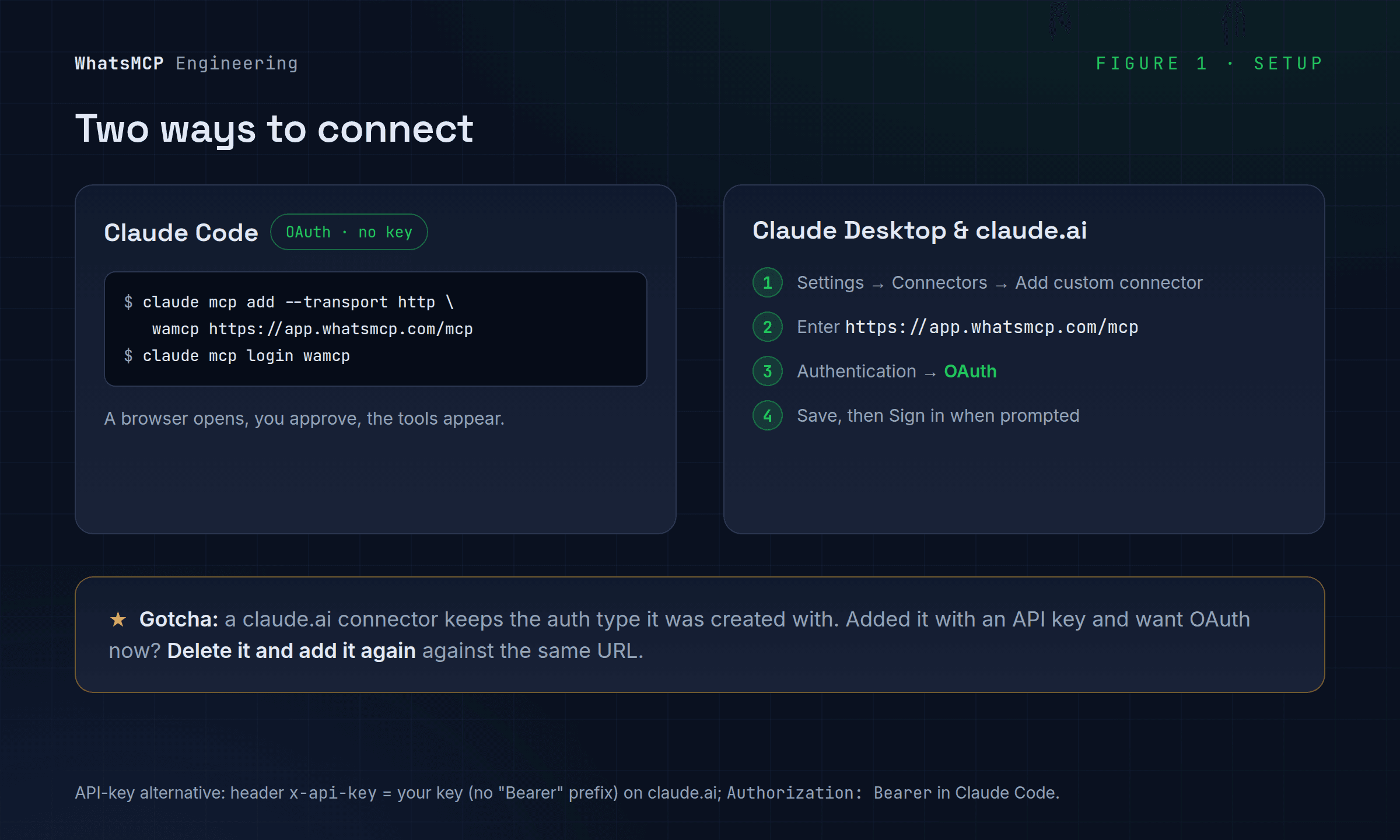
One gotcha worth knowing. A claude.ai connector keeps the authentication type it was created with. If you first added WhatsMCP with an API key and later want the smoother OAuth flow, the connector won't switch on its own — delete it and add it again against the same URL, choosing OAuth this time.
Getting an API key
If you go the key route, create one at Console → API keys with Create key. Keys look like wamcp_live_… and are shown exactly once, so store the value somewhere safe when it appears — a lost key is replaced, not recovered. You can revoke a key, or any connected client, from the console at any time.
What's happening under the hood
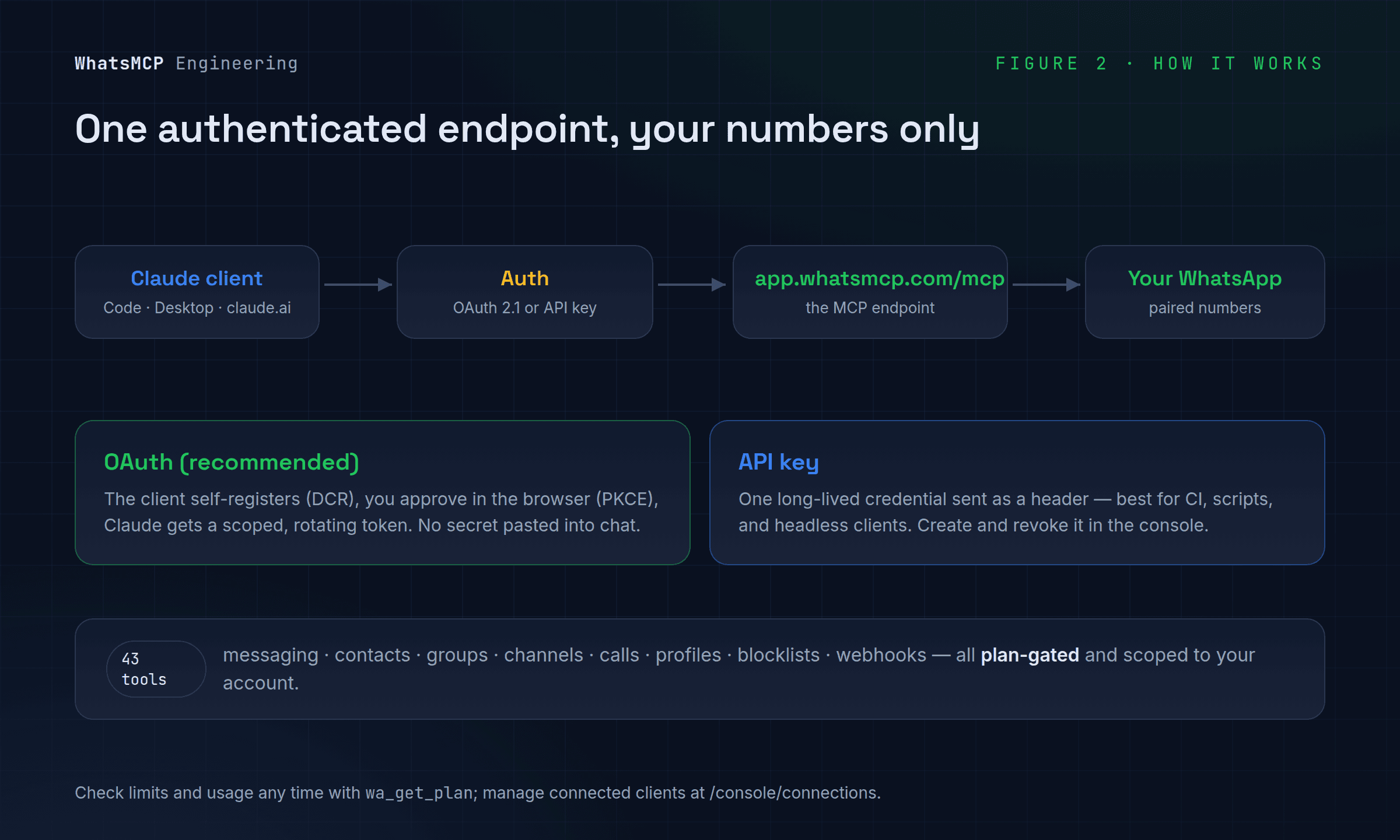
When you connect over OAuth, your Claude client registers itself with WhatsMCP automatically (Dynamic Client Registration), you approve access in the browser (Authorization Code with PKCE), and Claude receives a scoped, rotating token. No secret is ever pasted into a chat window. An API key is the simpler, coarser alternative: one long-lived credential sent as a header, best for scripts and automation.
Either way you land in the same place — a surface of 43 tools covering messaging, contacts, groups, channels, calls, profiles, blocklists and webhooks. Every tool runs against your paired numbers only, and each is gated by your plan, so an agent can never reach beyond what your account allows. Check where you stand any time with wa_get_plan.
Three things to try
Once connected, you drive everything in plain language — Claude picks the right tools. Here are three prompts that show the range.
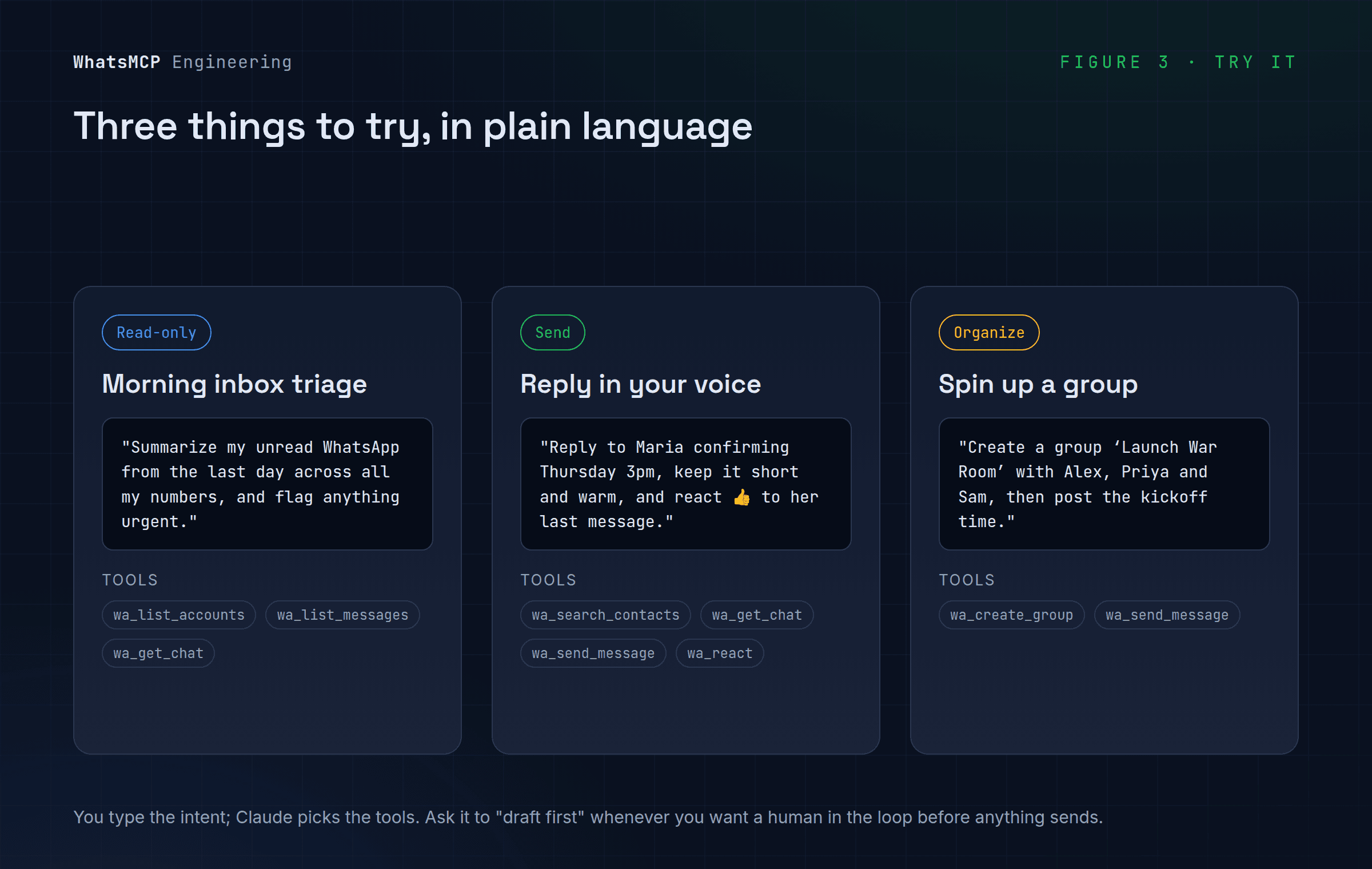
1. Morning inbox triage. Ask Claude to catch you up:
"Summarize my unread WhatsApp from the last day across all my numbers, and flag anything that looks urgent or needs a reply today."
Claude fans out with wa_list_accounts and wa_list_messages, reads the relevant threads with wa_get_chat, and hands you a ranked digest instead of a wall of notifications. Nothing is sent — this is read-only — so it's a safe first test.
2. Reply in your own voice. When you've decided what to do, let Claude do it:
"Reply to Maria confirming Thursday at 3pm works, keep it warm and short, and react 👍 to her last message."
It resolves the contact with wa_search_contacts, checks the thread with wa_get_chat for tone and context, sends with wa_send_message, and acknowledges with wa_react. You can always ask it to draft first and show you before sending.
3. Spin up a group and announce. Coordinate a launch, an event, or an on-call rotation without leaving the chat:
"Create a WhatsApp group called 'Launch War Room' with Alex, Priya and Sam, then post the kickoff time — Friday 9am — and pin the agenda link."
Claude looks up the members, creates the group with wa_create_group, and posts the opening message with wa_send_message — returning the invite link so you can share it further.
A few good habits
- Let Claude draft before it sends when you're getting started. "Show me the reply first" keeps a human in the loop.
- Use least privilege. If you only need read access for a task, a read-scoped setup keeps the blast radius small.
- Manage access from the console. Every connected client and key is listed at Console → Connections; revoke anything you no longer use.
- Watch your plan.
wa_get_planshows message and account limits and how much you've used, so a busy day doesn't surprise you.
That's it
Two commands, or four clicks, and Claude is on WhatsApp — reading, replying, and organizing through one authenticated endpoint you control. Full per-client instructions and the complete tool reference live at whatsmcp.com/docs/mcp.
Next, wire up webhooks so your own systems — and your agents — react to inbound messages the instant they arrive.
About WhatsMCP Engineering
Engineering Team at WhatsMCP. The team building WhatsMCP's MCP server and SIP bridge — the people who wrote the code these posts describe.